
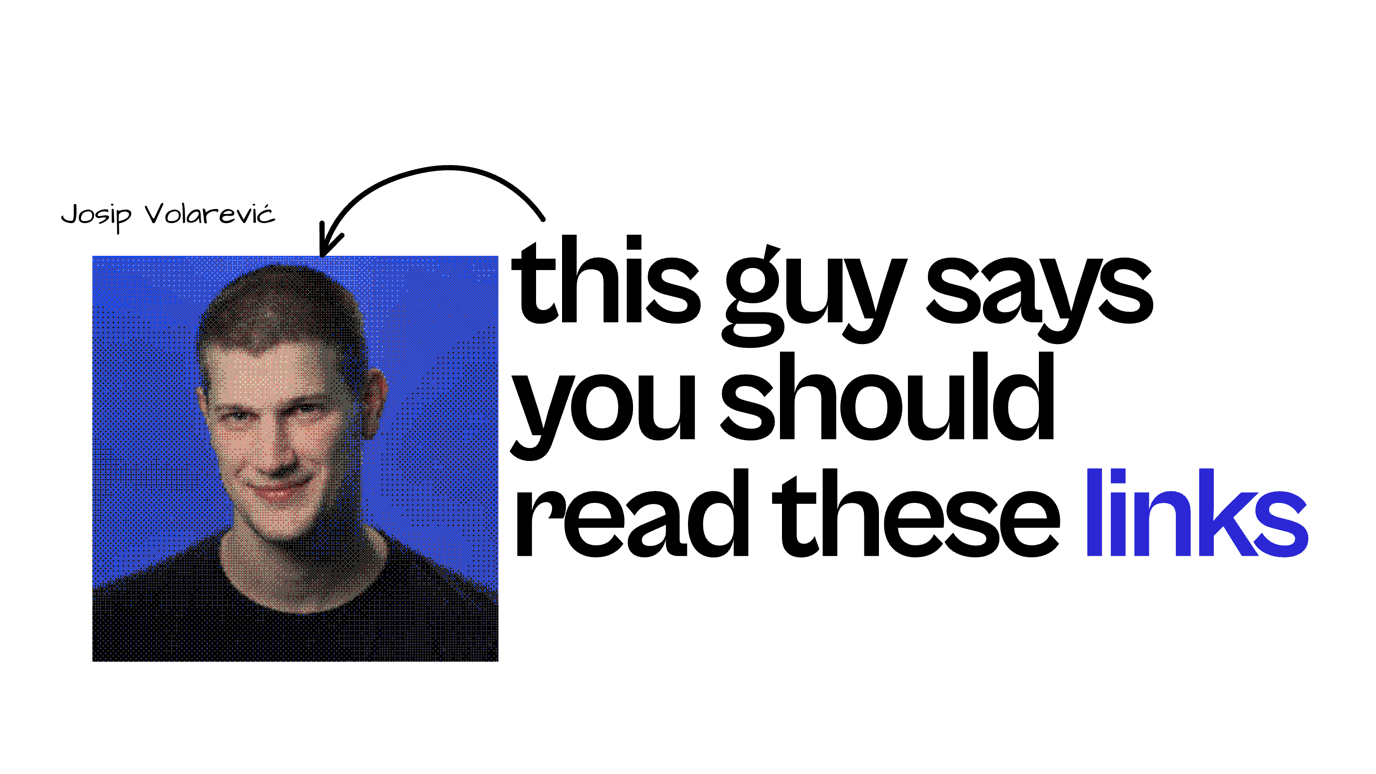
Josip Volarević has spent a lot of time around early-stage founders, and he sent this over to me with a simple note: you might find this useful, for yourself and for the founders you're helping. I did. So I'm sharing it here for all early-stage founders.
I've kept his grouping, with a line on why each one earns its place. Bookmark this page and work through it slowly. One link per coffee is the right pace.
Pitching, applications, and getting noticed
The through-line in this section: attention is earned in the first sixty seconds, whether it's a DM, a deck, or a demo video.
How to DM people. Josip's own playbook for cold outreach. Most DMs die because they ask too much, too early, of someone who has no reason to care yet.
How to win Colosseum. Josip's breakdown of what separates winning Colosseum hackathon submissions from the other few thousand.
DoorDash's application video for YC S13. One minute, four founders, zero production value, and it got them into Y Combinator's Summer 2013 batch. The bar is clarity, not polish.
Nail your pitch with Pixar's storytelling formula. The “once upon a time… until one day…” structure, applied to startup pitches. A narrative arc beats a stack of bullet points.
Examples of exceptional ability. Concrete examples of what evidence of exceptional ability actually looks like, plus an addendum with more. Useful for calibrating your own bar.
How to think about traction. A sharp reframe on what investors actually read as traction at the earliest stages. It's a slope, not a number.
YC: How to design a better pitch deck. YC's classic on deck legibility: big fonts, one idea per slide, decks that still work when skimmed in eight seconds.
YC: How to build your seed round pitch deck. The companion piece: the exact slides a seed deck needs, and what each one has to prove.
Design a deck like a children's book. If a slide needs to be studied, it has failed. One picture, one sentence, next page.
The greatest pitch ever. Proof that a pitch is a performance, not a document.
Earn a Solana retweet. What it takes to get the ecosystem to amplify your launch: mostly, building something worth retweeting and showing it specifically.
Don't run out of money. Solana's co-founder on the one unforgivable startup mistake. Default alive is a strategy.
When you need fuel
Tactics are cheap when morale is gone. This section is for the weeks when nothing works.
Wish you suffering. The uncomfortable case for wanting the hard road: the parts you'd skip are the parts that build you.
Relentlessly resourceful. Paul Graham's two-word definition of a good founder. If the phrase doesn't describe you yet, this essay explains what to aim for.
The right kind of stubborn. Persistent founders listen and adapt; obstinate ones just don't listen. Knowing which one you're being is half the battle.
Charisma as a force multiplier. Charisma isn't a gift. It's attention, energy, and conviction, and it compounds everything else you do.
How to do public speaking. A practical thread on speaking well in public, a founder skill that pays off in pitches, panels, and all-hands alike.
Optimize for signal. On spending your time where it generates real signal instead of comfortable noise.
Lock in. Sometimes the strategy is simply: fewer inputs, more output. Close the tabs.
For the long game
Josip filed these under “less important.” Read them anyway, just later.
How to do great work. The broadest essay Paul Graham has written on doing work that matters. Not startup-specific, which is exactly why it holds up.
A word to the resourceful. Why some founders are easy to help and others are impossible, and why investors can tell within minutes.
Contrarian take on building in public. The counterargument to the build-in-public orthodoxy. Worth reading precisely because everyone else in your feed is telling you the opposite.
None of these will build the company for you. But a founder who has internalized this list DMs better, pitches better, and lasts longer. And lasting is most of the game. Thanks, Josip.
This is a living list. Josip and I will keep updating it as we find more resources worth adding.